
Low-Code AI Workflow Builders: Dify, Langflow, n8n and What Happened to Flowise
If you built an internal chatbot on Flowise last year, you found out in August that the repository is now read-only. The maintainers archived FlowiseAI/Flowise on 13 August 2026 and pointed everyone to a short post called "The Future of Flowise". The canvas you liked still works. Nobody is going to patch it.
That's the real question with low-code AI builders in late 2026. They all let you drag an LLM node, a retriever and a tool onto a canvas and wire them up. What separates them is who maintains the thing, what the licence lets you do with it, and how much damage a bad deployment can do. This post covers the four names that come up most: Dify, Langflow, n8n and Flowise.
Where each one stands in November 2026
| Latest release (GitHub) | Licence | Runs on | Who's behind it | |
|---|---|---|---|---|
| Dify | v1.19.0, 4 Nov 2026 | Dify Open Source License (Apache 2.0 plus conditions) | Docker Compose | the langgenius organisation |
| Langflow | 1.13.1 marked Latest, 4 Nov 2026 | MIT | Python 3.10 to 3.14, or Docker | IBM, through DataStax |
| n8n | 2.46.6 stable, 4 Nov 2026 | Sustainable Use License, plus an Enterprise licence for .ee files | Docker or npm | n8n |
| Flowise | final npm release 3.1.4, 29 Jul 2026 | Apache 2.0 | Node.js 20 or newer | archived, no maintainers |
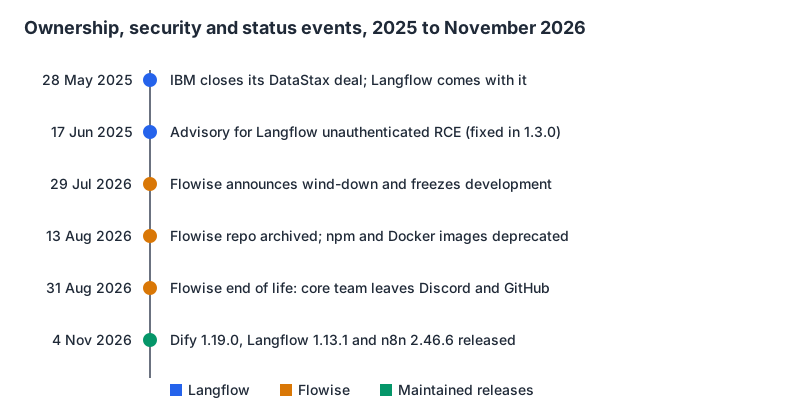
A few notes on that table. Langflow's release page lists a 1.12.10 published a day after 1.13.1, so it's maintaining two lines at once; pin whichever you're on and read the notes. n8n's releases page also shows a 3.1.0 pre-release, so a major version is coming. And Langflow's ownership is a chain: IBM closed its acquisition of DataStax in May 2025, and DataStax had already owned Langflow. The repo itself sits under the langflow-ai organisation and doesn't mention either company on its front page.
What happened to Flowise
The announcement lays out a three-step wind-down: a code freeze on 29 July 2026 (no new features, no PRs reviewed), the archive on 13 August with issues and PRs locked and npm packages and Docker images marked deprecated, and end of life on 31 August, when the core team left Discord and GitHub. The reason given is blunt. Developers are moving to coding agents, and in the maintainers' words, "the typical rigid workflow low-code approach quickly hits the limit when it comes to complexity."
Two practical things follow. First, the code stays available: the post says the Apache 2.0 code "is yours to keep building on," and it encourages forks. Second, nothing in the post mentions a hosted-service shutdown date or a migration tool, so if you're on Flowise you're choosing between owning a fork (including its security fixes) or rebuilding your flows somewhere else. If you are moving, our Dify and Langflow pages are the obvious starting points.
Rebuilding is less painful than it sounds if you treat the old flow as a spec. Export it, list each node's job (load documents, split, embed, retrieve, prompt, call tool), then recreate those steps. You keep the prompts and retrieval settings; credentials and any custom components have to be redone.
The licences are where people get caught
This part rarely shows up in demos, and it's the part your legal team will ask about.
Dify is "based on Apache 2.0 with additional conditions," and the LICENSE file spells them out. You can't use the source "to operate a multi-tenant environment" without written authorisation from Dify, and it defines a tenant as a workspace: "one tenant corresponds to one workspace." If you use Dify's frontend, you "may not remove or modify the LOGO or copyright information" in the console or apps. So running Dify for your own company is fine; selling a Dify-based SaaS where each customer gets a workspace needs a conversation with them first.
n8n is "fair-code." The Sustainable Use License says you may use or modify it "only for your own internal business purposes or for non-commercial or personal use," and may distribute it only "free of charge for non-commercial purposes." Files with .ee. in the name are under a separate Enterprise licence and need a licence key. Automating your own team's work is the intended use. Embedding n8n in a product you charge for isn't.
Langflow is MIT and Flowise is Apache 2.0. Neither restricts hosting or reselling beyond keeping the licence notices.
If you're comparing the two biggest app builders directly, our Dify vs Langflow comparison goes through features and pricing side by side.
What each one is actually good at
Dify is the most "finished product" of the group. It bundles workflows, RAG pipelines, agents, model management and observability in one workspace, and a non-developer can publish a chat app from it. Self-hosting needs at least 2 CPU cores and 4 GiB of RAM and Docker Compose 2.35.0 or later, per the install guide:
git clone --branch 1.19.0 --depth 1 https://github.com/langgenius/dify.git
cd dify/docker
cp .env.example .env
openssl rand -hex 32   # paste into DIFY_AGENT_LOCAL_SANDBOX_AUTH_TOKEN in .env
docker compose up -d
docker compose ps --all
Then open http://localhost/install. The hosted plans start with a free Sandbox (200 message credits, 1 member, 5 apps); Professional is $590 per workspace per year and Team is $1,590.
Langflow suits developers who want a canvas but expect to drop into Python. Components are editable Python, agents can call your other components as tools, and the docs describe both an MCP server (your flows become tools for MCP clients) and an MCP client. Install is one line with uv:
uv pip install langflow -U
uv run langflow run   # serves on http://127.0.0.1:7860
n8n is an automation platform first and an AI builder second. Its strength is the long list of SaaS integrations plus AI nodes for agents, LangChain-style chains, memory and vector databases, as its AI docs lay out. If the job is "when a ticket arrives, summarise it, look up the customer, post to Slack," n8n is the natural fit. Hosted pricing is per workflow execution: Starter is €20 a month (billed annually) for 2,500 executions and Pro is €50 for 10,000. If you're weighing it against other automation tools, see n8n vs Zapier AI and Activepieces vs n8n.
All three can also sit on the other side of an agent. There are MCP servers for n8n and Dify, and our post on automation platforms as MCP hubs covers n8n's three separate MCP features.
Security: these tools execute code for you
A visual builder that can run a Python component or call a shell tool is a remote code execution service with a nice UI. Treat it that way.
The clearest example is Langflow's CVE-2025-3248: a code-injection flaw in the /api/v1/validate/code endpoint that let "a remote and unauthenticated attacker" run arbitrary code. It affected versions before 1.3.0 and is rated 9.3 (critical) under CVSS v4. Langflow has tightened defaults since: per the README, official release packages and Docker images disable automatic login and expect you to set LANGFLOW_SUPERUSER_PASSWORD, though development branches still auto-login. The 1.13.1 notes are mostly hardening, including confining file access in two loaders and tightening MCP and auth handling.
Gotchas that apply to all of them:
- Don't publish the editor to the internet. Put it behind your VPN or SSO and expose only the published app or API endpoint.
- Change every generated secret. Dify's guide has you generate the sandbox token and set separate, strong values for
PLUGIN_DAEMON_KEYandPLUGIN_DIFY_INNER_API_KEY. - Scope API keys. Give the builder its own model API key with a spend limit, so a leaked flow can't run up your main account.
- Plan upgrades. You're running a fast-moving app with frequent releases. Pin versions and read release notes before pulling
latest.
If your flows hand tools to an agent, our guide to running AI agents safely covers sandboxing and egress controls that apply here too.
When a canvas stops paying off
You don't have to agree with Flowise's maintainers to recognise the signs of a canvas that has hit its ceiling: flows with dozens of nodes nobody wants to touch, no tests, diffs that are giant JSON blobs, and branching logic that would be ten lines of code. At that point an agent framework in a normal repository gives you code review, unit tests and version history. Our guide to agent frameworks compares LangGraph, CrewAI and the vendor SDKs.
The canvas still wins for prototypes, for teams where the person who understands the process can't write code, and for glue automations that change weekly.
A decision rule
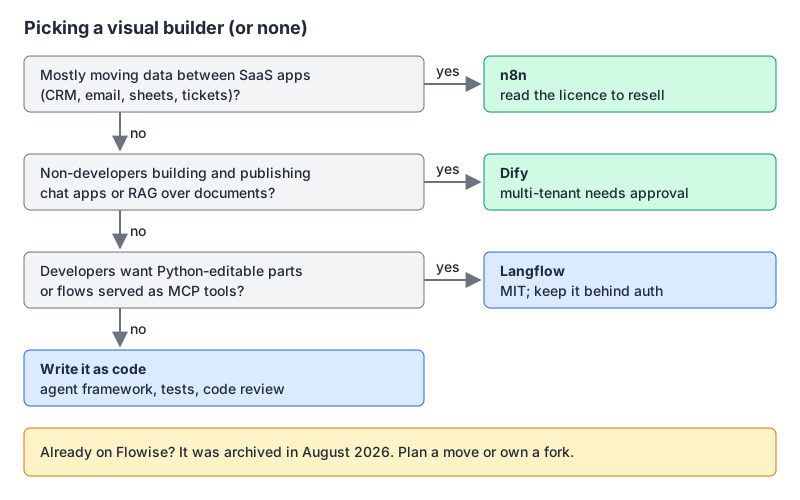
- Mostly connecting SaaS apps, with some AI steps? n8n, as long as you're using it internally.
- Non-developers publishing chat apps or RAG over documents? Dify, and talk to Dify before running it multi-tenant.
- Developers who want Python escape hatches, MCP and a permissive licence? Langflow, kept behind authentication and on a current release.
- On Flowise today? Pick one of the above or commit to owning a fork. Don't sit on an archived project that runs code.
- Flow has grown past what you'd review in a pull request? Move it to code.
Written by AIDToolStack Editorial
Researched from official documentation, specifications and vendor pages, listed under Sources below. Last checked November 2026.
Sources
- github.com/FlowiseAI/Flowise
- github.com/FlowiseAI/Flowise/discussions/6727
- github.com/langgenius/dify/releases
- github.com/langflow-ai/langflow/releases
- github.com/n8n-io/n8n/releases
- www.npmjs.com/package/flowise
- www.dbta.com/Editorial/News-Flashes/IBM-Officially-Closes-Acquisition-of-DataStax-169711.aspx
- github.com/langgenius/dify/blob/main/LICENSE
- github.com/n8n-io/n8n/blob/master/LICENSE.md
- docs.dify.ai/en/getting-started/install-self-hosted/docker-compose
- dify.ai/pricing
- docs.langflow.org/
- docs.n8n.io/advanced-ai/
- n8n.io/pricing/
- github.com/advisories/GHSA-rvqx-wpfh-mfx7
- github.com/langflow-ai/langflow
- github.com/advisories?query=CVE-2025-3248
Related Posts
Explore on AIDToolStack
Discover tools and servers featured in our directory.
AI Tools
MCP Servers
Sponsor Our Newsletter
Reach thousands of developers who are actively evaluating AI tools, MCP servers, and dev infrastructure. Our weekly newsletter goes to engaged technical decision-makers.
All sponsored content is clearly labeled per our editorial policy.