
Claude Code Pricing Explained: Plans, API Billing and Usage Limits
Ask three developers what Claude Code costs and you can get three correct answers: $20 a month, $200 a month, or "about thirteen bucks a day." That's because the same claude command can be billed in completely different ways depending on how you signed in. A subscription login draws from a usage allowance. An API key bills every token. A cloud provider puts the tokens on your AWS, Google Cloud or Azure invoice.
The billing path matters more than the plan name. A stray ANTHROPIC_API_KEY in your shell profile is enough to move you from a flat monthly fee to metered billing without you noticing. Everything below comes from Anthropic's own pages as of November 2026. Anthropic says on its pricing page that plans and prices can change, so check the linked page before you commit a budget to it.
The four ways to pay
Anthropic's cost management docs split Claude Code billing by how a developer authenticates:
| Setup | What you pay | What stops you | Where you see spend |
|---|---|---|---|
| Pro, Max or Ultra subscription | A flat monthly price | 5-hour and weekly usage windows | /usage plan bars |
| Team or Enterprise seat | Per seat (Enterprise adds usage at API rates) | Seat allowance, then admin spend limits | Org analytics spend report |
| Claude Console API key | Per token | Workspace spend limits and rate limits | Console cost page |
| Amazon Bedrock, Google Cloud, Microsoft Foundry | Per token, on your cloud bill | Your cloud's budget controls | Your cloud billing console |
The docs add that if an organization mixes sign-in methods, "each developer is metered according to the one they authenticated with." So a team on Team seats can still run up API charges if a few people use Console keys.
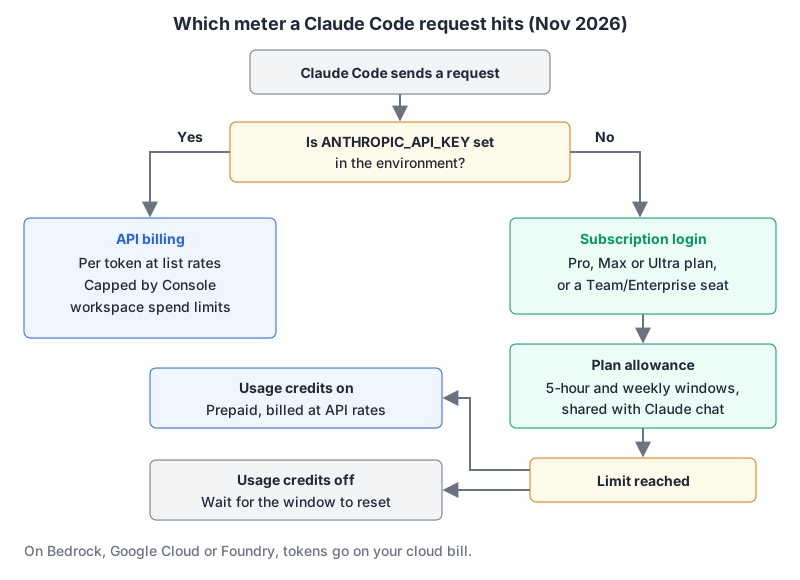
That API key check is the gotcha I'd look at first. Anthropic's help article on Pro and Max plans says that when the variable is set, Claude Code "will use this API key for authentication instead of your Claude subscription", and the usage is billed as API charges. Run env | grep ANTHROPIC before you wonder why your plan bars aren't moving.
The individual plans
From claude.com/pricing, as of November 2026:
| Plan | Price | Claude Code | Usage |
|---|---|---|---|
| Free | $0 | No | Limited |
| Pro | $20/month, or $17/month billed annually ($200 up front) | Yes | More than Free, every 5 hours and every week |
| Max | $100/month | Yes | 5x Pro, every 5 hours and every week |
| Ultra | $200/month | Yes | 10x Pro per week, no 5-hour limit for verified accounts |
A few details that the headline prices hide:
- No fixed message count. The pricing page says how fast you reach a limit depends on the model, the length of your chats and the size of your files. It also says Anthropic may limit usage "in other ways, such as weekly and monthly caps".
- The included API credits aren't for Claude Code. Max now comes with $100 a month in API credits and Ultra with $200, for building on the Claude Platform. The help article is explicit that these monthly API credits can't be used in Claude Code or the Claude apps, including for usage credits. Don't count them toward your coding budget.
- Fable is metered separately. On Pro, the top-end Fable models are "paid with usage credits". On Max and Ultra they're included "up to half your weekly limit", and the help article says those plans have a separate weekly limit for Fable.
- The limit is shared with chat. "These limits are shared across Claude and Claude Code, meaning all activity in both tools counts against the same limits," per the help article. A long research chat in the browser eats into tonight's refactor.
What actually eats your allowance
The costs docs have a section on why usage climbs in a long session, and it's the most useful thing on this topic. The short version: Claude Code sends your full conversation with every request, and each round of tool calls is another request carrying that history. With prompt caching, the history is re-read at the cached rate, but it's still re-read. A one-line question at the end of an all-day session draws usage for the whole conversation.
Other things the docs list as quiet spenders:
- Cache misses after a break. Your first message after the cache lifetime expires reprocesses the full context.
- Subagents and agent teams. Every subagent sends its own requests. Agent teams use "approximately 7x more tokens than standard sessions" when teammates run in plan mode.
- Scheduled tasks. A
/looptask fires on its interval even while you're idle, sending your context each time. - Thinking. Thinking tokens are billed as output, and the docs say you can't turn thinking off on Opus 5.5, Sonnet 5.5, Haiku 5.5 or the Fable models. Lowering
/effortis the lever there. - Compaction.
/compactreads the whole conversation it summarizes./clearcosts nothing.
On a subscription, /usage now shows where your recent usage went (skills, subagents, plugins, individual MCP servers) plus recommendations, each tagged with the share of usage it applies to. On recent versions you can press f to apply the ones Claude Code can handle. The tips post covers more of the day-to-day habits.
When you do hit the wall, the message tells you which wall. "You've hit your session limit" or "weekly limit" applies across all models, so /model won't help. A model-specific message like "You've hit your Opus limit" can be worked around by switching to another model family, per the docs.
Usage credits: the overflow valve
Pro, Max and Ultra subscribers can turn on usage credits to keep working past a limit. According to Anthropic's help article, credits are prepaid, usage is "billed at standard API pricing rates", and you can set a monthly spend limit or leave it unlimited. They apply to Claude Code as well as chat. In the CLI, /usage-credits opens the right settings page for your role. Team or Enterprise members without billing access get a confirmation prompt and the request goes to their admins.
Treat this as the moment your subscription turns into API billing. Which makes the API prices worth knowing.
What API-rate billing costs, with the arithmetic
Per-token prices from the Claude API pricing docs, per million tokens, as of November 2026:
| Model | Input | 5-min cache write | Cache read | Output |
|---|---|---|---|---|
| Claude Fable 5.1 | $10 | $12.50 | $0.25 | $50 |
| Claude Opus 5.5 | $4 | $5 | $0.20 | $20 |
| Claude Sonnet 5.5 | $2 | $2.50 | $0.10 | $10 |
| Claude Sonnet 4.6 | $3 | $3.75 | $0.30 | $15 |
| Claude Haiku 5.5 (prompts up to 100K tokens) | $0.10 | $0.125 | $0.01 | $0.50 |
The costs docs show a sample /usage session on claude-sonnet-4-6: 1.2k input, 5.3k output, 940k cache read and 50k cache write tokens, totalling $0.55. You can check that from the table:
input        1,200 x $3.00 / 1M  = $0.0036
output       5,300 x $15.00 / 1M = $0.0795
cache read 940,000 x $0.30 / 1M  = $0.2820
cache write 50,000 x $3.75 / 1M  = $0.1875
total                              $0.5526
Two things jump out. Cache traffic is about 85% of that bill, which is the "long session" effect in numbers. And the same token mix on Sonnet 5.5 comes to roughly $0.27 (0.0024 + 0.053 + 0.094 + 0.125), about half, because both the base price and the cache-read multiplier dropped.
For a bigger picture, Anthropic's costs docs say that across enterprise deployments the average is "around $13 per developer per active day and $150-250 per developer per month", with 90% of users under $30 per active day. If your usage looks like that average, API billing lands in the same range as Max or Ultra. The plans don't publish token quotas, though, so there's no exact break-even to compute. Running a week on each and comparing is the only honest method.
Two multipliers to remember: US-only inference costs 1.1x, and fast mode on Opus 5.5 is $8 input and $40 output per million tokens, double the standard rate.
Teams and Enterprise
The pricing page lists Team for 2 to 150 people:
- Standard seat: $20 per seat a month billed annually, $25 monthly, with "more usage than Pro".
- Premium seat: $100 annually, $125 monthly, with "5x more usage than standard seats".
- Enterprise: $20 per seat a month billed annually, 20-seat minimum, plus usage at API rates.
Claude Code is included with every Team seat, per Anthropic's Team and Enterprise help article. The seat allowance resets on a rolling five-hour window and a weekly window and is shared with Claude chat and Cowork. On usage-based Enterprise plans "there are no per-seat usage limits"; you pay for what's consumed. Admins can turn on usage credits and set spend limits at the organization, group or member level. Mixing seat types is allowed, so the practical move is standard seats for most people and premium for the two or three who live in the terminal.
If you go the Console route instead, the first Claude Code login creates a "Claude Code" workspace you can put a spend limit on. The docs suggest per-user rate limits that shrink as teams grow, from 200k-300k tokens per minute for 1-5 users down to 10k-15k for 500+, because fewer people are active at once.
Which setup to pick
- Trying it out, or a few sessions a week: Pro. It's the cheapest plan that includes Claude Code.
- You hit Pro's limits most days: Max. Move to Ultra if the 5-hour window is what stops you, since verified Ultra accounts don't have one.
- CI jobs, scripts, headless runs: a Console API key in its own workspace with a spend limit. Predictable per-token billing beats a shared allowance you can't see from a pipeline.
- A team under 150: Team seats, mixed by workload. Look at Enterprise if you want usage-based billing or the Enterprise Analytics API.
If you're still choosing between tools, the Claude Code vs Cursor comparison and Claude Code vs GitHub Copilot cover the non-price differences, and the Claude Code tool page has the current plan summary.
Before you blame the plan for running out, check three things: env | grep ANTHROPIC for a stray key, /usage for the breakdown, and how long your current session has been open.
Written by AIDToolStack Editorial
Researched from official documentation, specifications and vendor pages, listed under Sources below. Last checked November 2026.
Sources
- claude.com/pricing
- code.claude.com/docs/en/costs
- support.claude.com/en/articles/11145838-using-claude-code-with-your-pro-or-max-plan
- support.claude.com/en/articles/11845131-use-claude-code-with-your-team-or-enterprise-plan
- support.claude.com/en/articles/12429409-extra-usage-for-paid-claude-plans
- platform.claude.com/docs/en/about-claude/pricing
Related Posts
Explore on AIDToolStack
Discover tools and servers featured in our directory.
AI Tools
MCP Servers
Sponsor Our Newsletter
Reach thousands of developers who are actively evaluating AI tools, MCP servers, and dev infrastructure. Our weekly newsletter goes to engaged technical decision-makers.
All sponsored content is clearly labeled per our editorial policy.