
LLM Observability Tools Compared: Langfuse, Helicone, W&B Weave and LangSmith
The first time an LLM feature misbehaves in production, you discover that your normal logs are useless. You can see that /api/chat returned 200 in 4.1 seconds. You can't see the prompt that was actually sent after the template filled in, which retrieved documents went with it, what the model said, what it cost, or which of the three tool calls went sideways. LLM observability tools exist to record exactly that.
This post compares four of them as of November 2026: Langfuse, Helicone, Weights & Biases Weave and LangSmith. Two of the four changed owners in the past year, and one of those changes affects whether I'd start a new project on it. If you only need plain request logs for a small app, our post on logging and observability for small applications may be enough.
Two ways to collect the data
Before comparing features, decide how you want data to leave your app. There are two models, and they shape everything else.
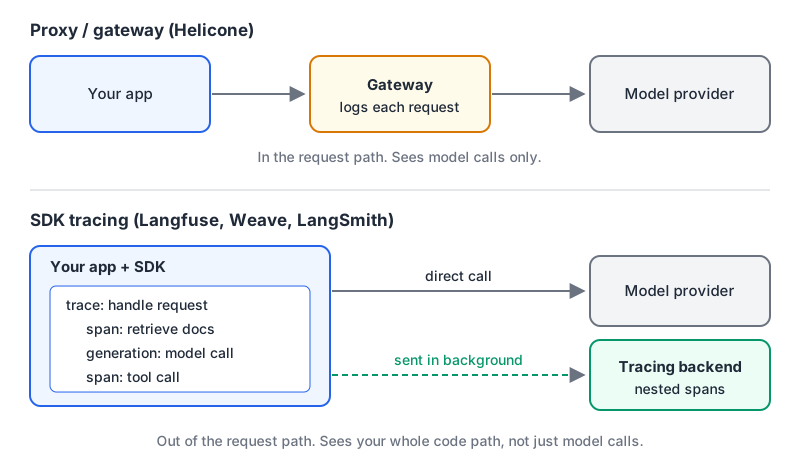
Proxy (gateway). Your app sends model calls to the tool's URL instead of the provider's. The tool forwards them and logs each request on the way. Helicone works this way. Its quick start is literally a base URL change on the OpenAI client:
from openai import OpenAI
import os

client = OpenAI(
    base_url="https://ai-gateway.helicone.ai",
    api_key=os.getenv("HELICONE_API_KEY"),
)
That's the lowest-effort setup there is, and the same page says the gateway gives you one OpenAI-compatible API for 100+ models, so switching providers is a change of model name. The cost: the proxy sits in the request path, and it only sees model calls. Your retrieval step, your tool code and your business logic are invisible to it.
SDK (tracing). You instrument your code and the SDK records nested spans (a request, the retrieval inside it, the generation inside that), then ships them to the backend in the background. Langfuse, Weave and LangSmith work this way. More setup, but you get the whole tree. Langfuse's get-started page offers a drop-in OpenAI wrapper so the first step is small:
# pip install langfuse; set LANGFUSE_PUBLIC_KEY, LANGFUSE_SECRET_KEY, LANGFUSE_BASE_URL
from langfuse.openai import openai
Weave's README starts with weave.init("<your-team>/<your-project-name>") and traces your own functions with the @weave.op decorator; for the OpenAI Agents SDK, Claude Agent SDK and Google ADK it says weave.init() is enough.
If you're debugging agents, I'd pick an SDK-based tool. A proxy can tell you the fourth model call was slow; it can't tell you that the fourth call happened because the retriever returned an empty list.
Status check: who owns what in November 2026
| Tool | Licence | Owner news | Self-hosting |
|---|---|---|---|
| Langfuse | MIT, except the ee folders (GitHub) | Joined ClickHouse on January 16, 2026; "No licensing changes planned" (announcement) | Free; Docker Compose to start, Helm for production |
| Helicone | Apache 2.0 (GitHub) | Acquired by Mintlify on March 3, 2026 and put in maintenance mode (Mintlify); pricing page now says it's "no longer part of Mintlify" | Docker Compose; Helm chart for enterprise |
| W&B Weave | Weave SDK is Apache-2.0 (GitHub) | W&B is part of CoreWeave; pricing now lives on CoreWeave's site | Dedicated deployment on Enterprise |
| LangSmith | Not stated on the pages I used | LangChain | Enterprise add-on only (docs) |
The Helicone row needs a sentence of its own. Mintlify's March post said Helicone "will continue operating in maintenance mode" with security updates, bug fixes and new models, and that Mintlify would help customers migrate to another platform. When I loaded Helicone's pricing page today, a banner read "Helicone is no longer part of Mintlify. Details to come soon." I couldn't find any detail beyond that banner. Until there's a public roadmap, I wouldn't start a new project on Helicone; existing users don't need to panic, since it's Apache-licensed and self-hostable.
Langfuse's move is less worrying. Its own post says Cloud "keeps running as-is" and self-hosting stays "a first-class path."
What self-hosting actually involves
"Open source and self-hostable" covers a wide range of effort, so it's worth knowing what you'd be running.
Langfuse is the easiest to try. The README has you clone the repo and run docker compose up; for production it recommends Kubernetes via Helm and ships Terraform templates for AWS, Azure and GCP. The ee folders are outside the MIT licence, so check which features you need before assuming the self-hosted build has everything Cloud has.
Helicone also starts with Docker Compose (./helicone-compose.sh helicone up per its README), but the production Helm chart is for enterprise workloads and you have to email the company for access.
LangSmith is a different class of project. Self-hosting is "an add-on to the Enterprise plan" and needs a licence key from sales. The self-hosting docs list the pieces: a frontend, backend, queue, platform backend, Playground and a code-execution backend, plus ClickHouse for traces, PostgreSQL for operational data, Redis or Valkey for queues and caching, and blob storage. Everything is bundled by default, but the docs recommend external storage in production. That's a job for whoever runs your Kubernetes clusters, not a weekend experiment.
Weave self-hosting sits under CoreWeave's Enterprise tier as a dedicated deployment, with options like customer-managed encryption keys and bring-your-own bucket.
Pricing as of November 2026
Each tool bills a different unit, which makes direct comparison awkward. Langfuse counts "units", Helicone counts requests, Weave counts megabytes ingested, and LangSmith counts traces.
| Tool | Free tier | First paid plan | Overage / notes |
|---|---|---|---|
| Langfuse (pricing) | Hobby: 50k units/month, 30 days of data, 2 users | Core, $29/month: 100k units, 90 days | $8 per 100k units, dropping to $6 above 50M |
| Helicone (pricing) | Hobby: 10,000 requests, 7-day retention | Pro, $79/month: 1-month retention | Usage-based past 10k requests |
| W&B Weave (pricing) | 1 GB ingestion/month | Pro, from $60/month: 1.5 GB/month | $0.10/MB on Pro |
| LangSmith (pricing) | Developer: 1 seat, 5k base traces/month | Plus, $39/seat/month: 10k base traces | Pay as you go; base traces kept 14 days, extended 180 |
Two things the table hides. LangSmith charges per seat on Plus, so a team of eight pays for eight seats before any traces. Weave charges by data volume, so long prompts and big retrieved contexts cost more than short ones even at the same request count. Langfuse's Core plan has unlimited users, which is why it often ends up cheapest for small teams.
Picking one
- You want open source you can run yourself, today, for free: Langfuse. MIT core, Docker Compose to start, Helm for production. Our Langfuse vs Helicone comparison goes deeper.
- Your team already uses W&B for model training: Weave keeps experiments and LLM traces in one place. See W&B vs Langfuse.
- You build on LangChain or LangGraph and won't self-host: LangSmith is the native choice; budget for seats.
- You want one gateway in front of many providers more than deep traces: Helicone's design fits, but weigh its unclear ownership first.
Whatever you choose, decide early what you must not log. Prompts contain user data, and these tools exist to capture prompts and outputs. Check each one's masking and retention options before the first production trace, not after the first privacy review. For the calling side of the same problem, see our LLM API best practices guide.
Written by AIDToolStack Editorial
Researched from official documentation, specifications and vendor pages, listed under Sources below. Last checked November 2026.
Sources
- docs.helicone.ai/getting-started/quick-start
- langfuse.com/docs/observability/get-started
- github.com/wandb/weave
- github.com/langfuse/langfuse
- langfuse.com/blog/joining-clickhouse
- github.com/Helicone/helicone
- www.mintlify.com/blog/mintlify-acquires-helicone
- docs.langchain.com/langsmith/self-hosted
- www.helicone.ai/pricing
- langfuse.com/pricing
- coreweave.com/forge-pricing
- www.langchain.com/pricing
Related Posts
Explore on AIDToolStack
Discover tools and servers featured in our directory.
AI Tools
MCP Servers
Sponsor Our Newsletter
Reach thousands of developers who are actively evaluating AI tools, MCP servers, and dev infrastructure. Our weekly newsletter goes to engaged technical decision-makers.
All sponsored content is clearly labeled per our editorial policy.