
LLM API Pricing Compared: OpenAI, Anthropic, Google and Mistral (November 2026)
Comparing LLM API prices looks like a lookup job: find the per-million-token number, pick the smallest. It falls apart quickly. Output tokens cost five times input on most models, so the input price alone tells you little. Caching can cut the input bill by 90% or more on one provider and charge you hourly storage on another. Batch discounts halve everything if you can wait. And two of the prices below are already scheduled to double.
This is a snapshot of list prices at OpenAI, Anthropic, Google and Mistral as of 7 November 2026, taken from each provider's own pricing page, plus the discounts that change the real number. Prices here move monthly. Treat the links as the source of truth and this page as the map.
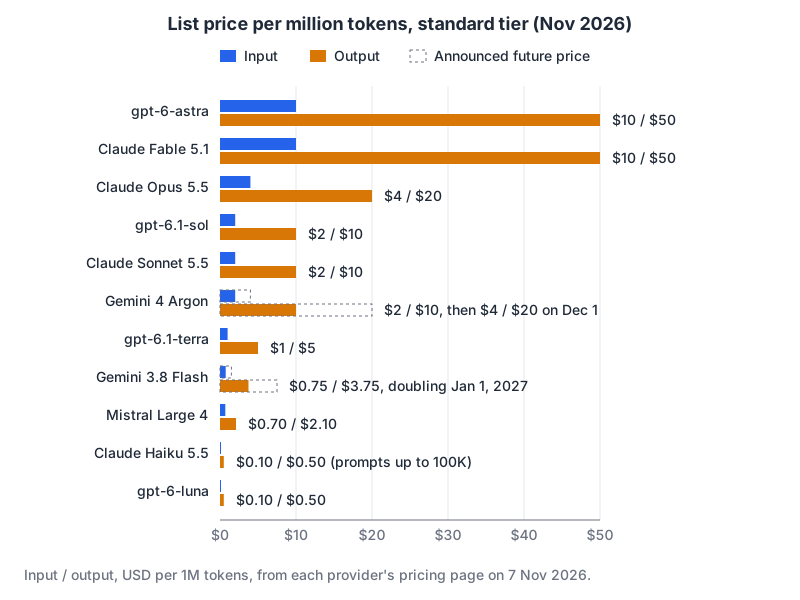
List prices for current models
Standard (non-batch) prices in USD per million tokens. For OpenAI these are the short-context prices; its page has a separate long-context toggle.
| Provider | Model | Input | Cached input | Output |
|---|---|---|---|---|
| OpenAI | gpt-6-astra | $10.00 | $1.00 | $50.00 |
| OpenAI | gpt-6.1-sol | $2.00 | $0.10 | $10.00 |
| OpenAI | gpt-6.1-terra | $1.00 | $0.05 | $5.00 |
| OpenAI | gpt-6-luna | $0.10 | $0.01 | $0.50 |
| Anthropic | Claude Fable 5.1 | $10.00 | $0.25 | $50.00 |
| Anthropic | Claude Opus 5.5 | $4.00 | $0.20 | $20.00 |
| Anthropic | Claude Sonnet 5.5 | $2.00 | $0.10 | $10.00 |
| Anthropic | Claude Haiku 5.5 (prompts up to 100K) | $0.10 | $0.01 | $0.50 |
| Gemini 4 Argon | $2.00 | $0.10 | $10.00 | |
| Gemini 3.8 Flash | $0.75 | $0.075 | $3.75 | |
| Gemini 3.5 Flash-Lite | $0.30 | $0.03 | $2.50 | |
| Gemini 3.1 Pro Preview (up to 200K) | $2.00 | $0.20 | $12.00 | |
| Mistral | Mistral Large 4 | $0.70 | $0.07 | $2.10 |
Sources: OpenAI API pricing, Claude API pricing, Gemini API pricing, and Mistral's Large 4 model card. Google's cached column is its context caching price; Anthropic's is the cache-hit price.
Notes the table can't hold:
- Gemini prices are about to double. Google's page lists Gemini 4 Argon at $4 input and $20 output "starting December 1, 2026", and Gemini 3.8 Flash at $1.50 and $7.50 starting January 1, 2027. Batch and caching prices for both double on the same dates. Gemini 2.5 Pro and 2.5 Flash are deprecated, and the page says their requests route automatically to 3.8 Flash and 3.5 Flash-Lite from December 1.
- Mistral's own pages disagree. The Mistral pricing page still gives "Mistral Large costs $0.5 /M tokens in and $1.5 /M tokens out" as its example, while the Large 4 model card lists $0.70 and $2.10. I've used the model card, since it names the version. The Mistral Small 4 and Codestral cards each show two prices ($0.15 and $0.60, and $0.30 and $0.90) without labelling which is input, so I left them out of the table. Mistral Medium 3.5 was retired on October 31, 2026, per its model card.
- OpenAI has promotions with end dates. The page says GPT-5.6 Sol's promotional pricing runs until November 30, 2026.
- Haiku 5.5 is priced by prompt length. Over 100,000 tokens, the whole request moves to $0.50 input and $2.50 output, even if part of it is a cache hit.
Batch discounts: half price if you can wait
All four providers offer roughly the same deal for asynchronous work:
| Provider | Batch discount | Notes |
|---|---|---|
| OpenAI | 50% | The Batch/Flex column is exactly half of standard, e.g. gpt-6.1-sol at $1 / $5 |
| Anthropic | 50% on input and output | Stacks with caching; fast mode can't be batched |
| 50% ("Batch API (50% cost reduction)") | Flex prices match Batch | |
| Mistral | 50% | "reduces the price by 50%", per the pricing page |
Anthropic's pricing docs say batch and caching discounts can be combined. If you run evals, backfills or nightly classification, batch is the easiest saving there is.
Going the other way, speed costs extra. OpenAI renamed Priority processing to Fast mode on July 30, 2026, at double the standard rate (gpt-6.1-sol is $4 / $20). Anthropic's fast mode for Opus 5.5 is $8 / $40, also double.
Prompt caching is where the providers really differ
This is the part that makes a straight price comparison misleading.
Anthropic charges for writes and discounts reads. A 5-minute cache write is 1.25x base input and a 1-hour write is 2x. Reads are 0.1x on most models, but 0.05x on Opus 5.5 and Sonnet 5.5 and 0.025x on Fable 5.1. The docs say caching pays off after one read with the 5-minute cache and after two reads with the 1-hour one.
OpenAI now lists write prices too, with two durations: on gpt-6-astra, a 30-minute write is $12.50 and a 12-hour write is $25 against a $10 input price. On gpt-6.1-sol they're $2.50 and $5. The cached-input discount varies by model: 0.1x on gpt-6-astra and gpt-6-luna, 0.05x on gpt-6.1-sol and gpt-6.1-terra.
Google charges a cached-token price plus storage per hour. Gemini 3.8 Flash storage is $0.50 per million tokens per hour today, and Gemini 3.1 Pro Preview's is $4.50. Google lists Gemini 4 Argon as implicit caching only. Hourly storage makes long-lived caches of big documents a real cost, unlike Anthropic's and OpenAI's time-limited writes.
Mistral says cached input cuts input cost "by up to 90%", and Large 4's card lists cached input at $0.07, a tenth of the input price.
A worked example
Take a support-bot workload: 10,000 requests a day, each with 3,000 input tokens (2,000 of them a shared system prompt and docs prefix) and 500 output tokens. That's 30M input and 5M output a day.
Claude Sonnet 5.5 or gpt-6.1-sol, no caching:
  30M x $2  = $60
   5M x $10 = $50          total $110/day

Same, with the 2,000-token prefix cached (20M cached, 10M fresh):
  20M x $0.10 = $2
  10M x $2    = $20
   5M x $10   = $50        total $72/day, plus cache writes

Gemini 4 Argon: $110/day now, $220/day from Dec 1
Mistral Large 4: 30M x $0.70 + 5M x $2.10 = $31.50/day
Claude Haiku 5.5 or gpt-6-luna: 30M x $0.10 + 5M x $0.50 = $5.50/day
Any of the above via batch: roughly half
The cache-write cost depends on how often the prefix expires, which is why it's left out. Two lessons fall out of the arithmetic. Output was a sixth of the tokens but 45% of the uncached bill, and 69% of the cached one. And Sonnet 5.5 and gpt-6.1-sol have identical list prices, so on this workload the choice comes down to quality, latency and how many tokens each model actually produces.
That last point deserves its own warning. Tokens aren't a common unit across providers. Anthropic's docs say Claude 4.7 and later use a newer tokenizer that "produces approximately 30% more tokens for the same text." A per-token price can look identical and still bill differently for the same prompt. Run your real prompts through each API and compare the usage fields before trusting any table, this one included.
Other gotchas
- Thinking tokens are output tokens. Google's prices say "Output (incl. thinking)". A reasoning-heavy model can multiply your output count.
- Data residency costs extra. Anthropic charges 1.1x for US-only inference on Claude 4.6 and later. OpenAI charges a 10% uplift on regional processing endpoints for models released on or after March 5, 2026.
- Long context has its own tier. Gemini 3.1 Pro Preview goes to $4 / $18 above 200K tokens. Anthropic says its 4.6-and-later models, except Haiku 5.5, bill the full 1M context at standard rates.
How I'd choose
- Price your actual token mix, output included, not the input column.
- Put stable prompt prefixes first and turn on caching. It's usually the biggest single saving.
- Send anything that can wait an hour through batch.
- Check the dates: Gemini's increases and OpenAI's promotions both land within weeks of this post.
For more on how the two biggest providers compare beyond price, see OpenAI vs Anthropic and Claude vs Gemini. Our LLM API best practices guide and AI cost optimization guide cover retries, budgets and monitoring, and the OpenAI API and Anthropic API pages keep per-provider summaries.
Written by AIDToolStack Editorial
Researched from official documentation, specifications and vendor pages, listed under Sources below. Last checked November 2026.
Sources
- developers.openai.com/api/docs/pricing
- platform.claude.com/docs/en/about-claude/pricing
- aistudio.google.com/docs/pricing
- mistral.ai/pricing
- docs.mistral.ai/models/mistral-large-4-0
- docs.mistral.ai/models/mistral-small-4-0-26-03
- docs.mistral.ai/models/codestral-25-08
- docs.mistral.ai/models/mistral-medium-3-5-26-04
Related Posts
Explore on AIDToolStack
Discover tools and servers featured in our directory.
AI Tools
MCP Servers
Sponsor Our Newsletter
Reach thousands of developers who are actively evaluating AI tools, MCP servers, and dev infrastructure. Our weekly newsletter goes to engaged technical decision-makers.
All sponsored content is clearly labeled per our editorial policy.