
Redis, Valkey or Memcached: Choosing a Cache Server After the Licence Changes
Picking a cache used to take one word: Redis. Then in March 2024 Redis changed its licence, the Linux Foundation launched a fork within days, and in 2025 Redis added an open source licence back. If you're choosing a cache server in November 2026, you now have three serious options: Redis, Valkey and the old reliable Memcached. Like it or not, the licence is now part of the decision.
This post is about the server. For the patterns that sit on top (cache-aside, TTLs, stampedes), see our application caching strategies post.
The licence story, briefly and accurately
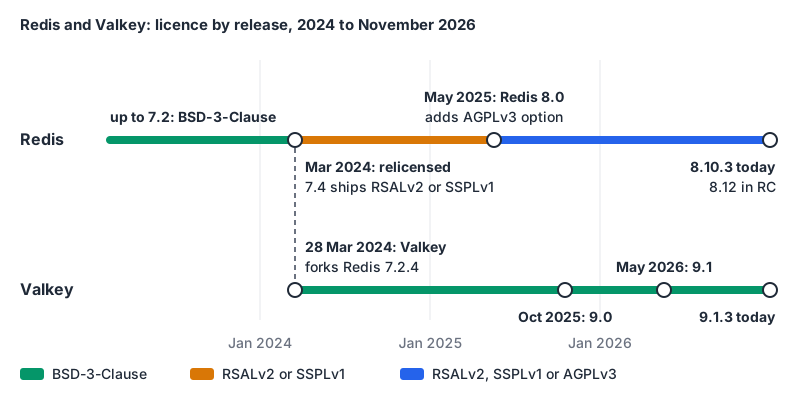
Redis's own licences page lays out three eras:
- Redis 7.2.x and earlier: BSD-3-Clause.
- Redis Community Edition 7.4.x to 7.8.x: "RSALv2 or SSPLv1", which the page itself notes are "neither of which are OSI-approved".
- Redis Open Source 8.0 and later: a tri-licence of RSALv2, SSPLv1 or AGPLv3. Redis 8.0.0 was tagged on 2 May 2025.
The page frames the AGPLv3 addition as "not a license change, but rather the inclusion of an option", and says there are "no plans to change or add to the current Redis Open Source license configuration". It also says RediSearch, RedisJSON, RedisTimeSeries and RedisBloom are now part of Redis Open Source under the same tri-licence. So Redis 8 is the first open source Redis with search, JSON and time series in the box.
Meanwhile, on 28 March 2024 the Linux Foundation announced Valkey, saying it "will continue development on Redis 7.2.4" under the BSD 3-clause licence, backed at launch by AWS, Google Cloud, Oracle, Ericsson and Snap. Valkey's history page says the first release was 7.2.5.
What does that mean for you?
- Using Redis as a cache inside your own app: the Redis page attributes the 2024 change to managed service providers that sold Redis without contributing much back, so that's the use the restrictive terms target. AGPLv3's key extra condition, in section 13, applies to a modified version that users interact with over a network. An unmodified Redis behind your app is a different situation, but this is a summary, not legal advice.
- Shipping Redis inside a product, or offering it as a service: read the licences with a lawyer, or use Valkey or Memcached, whose BSD-3 licences are about as simple as it gets.
- Your company bans AGPL and SSPL outright: Valkey or Memcached, decision made.
Where each project is in November 2026
| Redis | Valkey | Memcached | |
|---|---|---|---|
| Latest stable | 8.10.3 (26 Oct 2026) | 9.1.3 (26 Oct 2026) | 1.6.45 |
| In testing | 8.12-rc2 | 9.2.0-rc2 | n/a |
| Licence | RSALv2, SSPLv1 or AGPLv3 | BSD-3-Clause | BSD-3-Clause |
| Data model | Data structures, plus search, JSON, time series | Data structures | Raw values by key |
| Clustering | Server-side | Server-side | Client-side hashing |
Release data is from the GitHub releases for Redis and Valkey, and from memcached.org for Memcached. Redis is still shipping patch releases on older lines too. 7.4.12 came out the same day as 8.10.3.
Valkey: Redis 7.2's API, developed in the open
Valkey's migration guide says it's "compatible with Redis OSS 7.2 and all earlier open-source Redis versions", that existing client libraries connect without code changes, and that modules written against the RedisModule_ API still work. Moving from Redis 7.2 or earlier is treated as an upgrade.
The guide is also clear about the edge: "RDB files produced by Redis CE 7.4 and later are not compatible". If you're on Redis 7.4 or 8 with persistence, you can't just point Valkey at the old dump file. Plan a re-warm or a data copy at the application level.
A quirk worth knowing for monitoring scripts: Valkey's INFO reports redis_version:7.2.4 for backward compatibility. To see what you're actually running:
redis-cli INFO server | grep -E '^(server_name|valkey_version|redis_version):'Since the fork, Valkey has added things Redis 7.2 didn't have. The Valkey blog lists 9.0 (October 2025) with per-field expiration on hashes, atomic slot migration for resharding, and numbered databases in cluster mode. Valkey 9.1 shipped in May 2026, and a Valkey post from August 2026 says it cut per-key memory overhead by up to 44% for strings, with no command or configuration changes. That figure is the project's own and I haven't seen it independently reproduced.
Managed options matter too. On AWS, the ElastiCache pricing page says Valkey is priced 20% lower than Redis OSS for node-based clusters, and has "33% lower pricing" on Serverless with a 100 MB minimum data storage, against 1 GB for the other engines. If you're on ElastiCache anyway, that's a straightforward discount for the same protocol.
Redis 8: more in the box
The case for Redis itself in 2026 is breadth. Search, JSON, time series and probabilistic structures used to mean Redis Stack and a separate licence conversation. Now they're in Redis Open Source 8 under the same terms. If your "cache" is turning into a secondary index you query, or a store for JSON documents with secondary lookups, Redis 8 does that without bolting on modules.
It also has a commercial company behind it selling Redis Cloud and Redis Software, which some organisations prefer for support contracts. Our Redis vs Memcached comparison has the Redis Cloud plan details, and the Redis MCP server page covers agent access. Valkey and Redis 8 share the core commands, so our Redis command builder is handy for either.
Memcached: still the simplest thing that works
Memcached's docs describe a deliberately narrow design. Servers "are unaware of each other", with "no crosstalk, no synchronization, no broadcasting, no replication". The client library picks a server by hashing the key. Eviction is LRU by default. The server stores a key, an expiry, flags and raw bytes, and doesn't understand data structures.
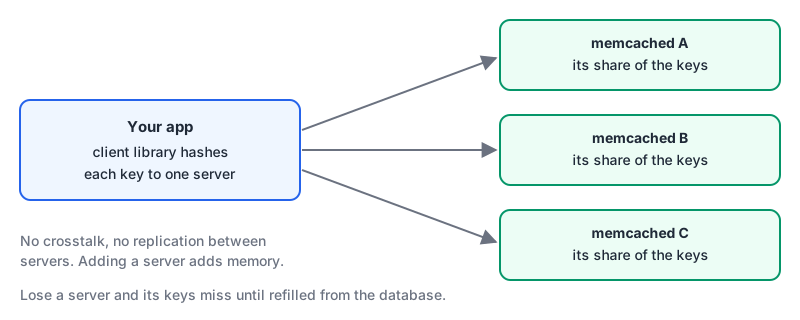
That's limiting if you want sorted sets or pub/sub, and freeing if you just want a big shared memory for rendered fragments and query results. Adding a server adds memory; nothing has to rebalance on the server side.
Two features close some of the gap with Redis-style servers:
- Extstore (memcached 1.6.0 and later) keeps keys and metadata in RAM and moves values to flash. You enable it at startup with something like
-o ext_path=/mnt/nvme/extstore:64G. The flash storage docs say it needs flash, not spinning disks, and that "a restart of memcached effectively empties flash". Some operations, likeincr/decrandappend, don't work on items that have been moved to flash. - Warm restart (1.5.18 and later) lets a graceful restart keep the cache. You start with
-e /tmpfs_mount/memory_fileand shut down with SIGUSR1. The restart docs are explicit that it doesn't make memcached crash-safe.
So treat Memcached as a cache in the strict sense: anything in it must be rebuildable from the database.
Gotchas when you switch
- Clients: Valkey works with existing Redis clients. Memcached uses a different protocol and different clients, so moving from Redis to Memcached is a code change, not a config change.
- Persistence assumptions: if some code quietly treats Redis as durable (session store, rate-limit counters, job queues), Memcached will lose that data on restart. Our rate limiting post has a Redis token bucket that needs atomic scripts, which Memcached doesn't offer.
- RDB files from Redis 7.4+ won't load in Valkey. Covered above, but it's the one that ruins a migration window.
- Version strings: don't gate behaviour on
redis_versionalone; Valkey reports 7.2.4 there. - Licence audits: if your compliance tooling flags SSPL or AGPL, check which Redis version your base image actually pulls. An image that tracks the newest Redis release crossed a licence boundary at 7.4.
The decision rule
- You only need a fast, disposable cache of bytes, and you'd like the fewest moving parts: Memcached 1.6.45, with extstore if your values are large and RAM is the constraint.
- You need Redis data structures, scripts, pub/sub or persistence, and want a BSD licence or the cheaper ElastiCache tier: Valkey 9.1.
- You want search, JSON or time series in the same server, or a vendor support contract, and your licence policy accepts AGPLv3, SSPLv1 or RSALv2: Redis 8.10.
If you're already on Redis 7.2 or earlier and happy, Valkey is the low-drama upgrade path. If you're on Redis 7.4 or later, staying on Redis and moving to 8 is the easier move, because the data files carry over.
Written by AIDToolStack Editorial
Researched from official documentation, specifications and vendor pages, listed under Sources below. Last checked November 2026.
Sources
- redis.io/legal/licenses/
- github.com/redis/redis/releases
- github.com/redis/redis/releases/tag/8.0.0
- www.linuxfoundation.org/press/linux-foundation-launches-open-source-valkey-community
- valkey.io/topics/history/
- valkey.io/topics/migration/
- valkey.io/blog/
- github.com/valkey-io/valkey/releases
- aws.amazon.com/elasticache/pricing/
- memcached.org/
- docs.memcached.org/
- docs.memcached.org/features/flashstorage/
- docs.memcached.org/features/restart/
- www.gnu.org/licenses/agpl-3.0.en.html
Related Posts
Explore on AIDToolStack
Discover tools and servers featured in our directory.
AI Tools
MCP Servers
Sponsor Our Newsletter
Reach thousands of developers who are actively evaluating AI tools, MCP servers, and dev infrastructure. Our weekly newsletter goes to engaged technical decision-makers.
All sponsored content is clearly labeled per our editorial policy.